
There’s a certain charm to spotting a thoughtfully designed vehicle out on the road. Not the loud, overdone kind that tries too hard—but something balanced, clean, and just… right. It doesn’t interrupt your day, yet somehow, it lingers. You might not even realize it in the moment, but later, when you hear that brand name again, it feels familiar. Almost like you’ve known it longer than you have.
That’s the understated power of vehicle branding. It doesn’t shout. It simply shows up—again and again—until it becomes part of the landscape.
It All Starts with an Idea, Not Just a Design
A lot of people assume vehicle branding begins with colors or logos. But honestly, it starts earlier than that. It begins with intention—what do you want people to feel when they see your vehicle? Trust? Curiosity? Maybe just a sense that your business is reliable and present.
This is where vehicle design services quietly do their best work. It’s not just about making something look good on a screen. It’s about translating a brand’s personality onto a moving surface, where proportions, angles, and even door handles come into play.
Designing for a vehicle isn’t like designing for a website or a flyer. There are curves, edges, and unexpected breaks in the surface. A design that looks perfect digitally might fall apart when applied to a real vehicle. That’s why thoughtful planning matters—it ensures the final result feels cohesive, not patched together.
Why Simplicity Often Wins
If you’ve ever seen a vehicle cluttered with text, you know how quickly things can go wrong. Too many details, too many messages—it becomes noise. And people don’t engage with noise. They ignore it.
The truth is, most people see a branded vehicle for just a few seconds. Maybe it passes by at a traffic light, or it’s parked across the street while they’re in a hurry. That’s not much time. So the message needs to land quickly.
A clean layout, a readable font, and a strong visual anchor—these things matter more than squeezing in every possible detail. It’s a bit like storytelling. You don’t need every word to make an impact. Sometimes, less really does say more.
Materials That Make It Possible
Now, here’s where things get interesting. The transformation from a plain vehicle to a branded one doesn’t rely on paint anymore. Modern branding leans heavily on vinyl wraps, and for good reason.
They’re flexible, durable, and surprisingly forgiving. Unlike traditional paint jobs, wraps can be removed or updated without damaging the vehicle underneath. That’s a huge advantage for businesses that evolve over time or want to refresh their look without starting from scratch.
And the finish options? Matte, gloss, satin, textured—there’s a lot of room to experiment. A matte black wrap, for instance, gives off a completely different vibe compared to a glossy, vibrant design. It’s subtle, but those details shape how people perceive your brand.
The Difference Between “Done” and “Done Right”
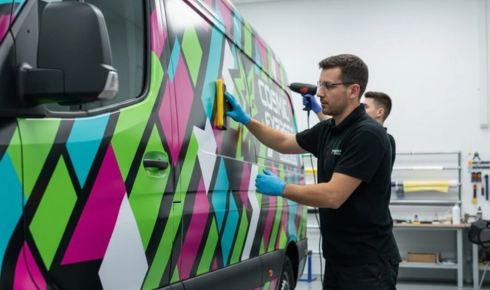
Here’s something people don’t always consider—the application process. You can have the most beautiful design in the world, printed on high-quality material, but if it’s not applied correctly, it shows. Bubbles, misalignment, peeling edges… it all adds up, and not in a good way.
That’s why professional installation isn’t just a nice-to-have—it’s essential. Skilled installers understand how to work with the material, how to stretch it over curves without distortion, and how to ensure it adheres properly over time.
It’s a bit like tailoring a suit. Off-the-rack might look okay, but a well-fitted piece? That’s a different level entirely. The same principle applies here. When a wrap is installed with precision, it feels seamless, almost like it was always part of the vehicle.
Real-World Visibility Beats Digital Noise
We live in a time where people are constantly bombarded with ads. Pop-ups, banners, sponsored posts—it’s endless. And naturally, people have learned to tune most of it out.
Vehicle branding, though, operates differently. It doesn’t interrupt. It integrates. It becomes part of someone’s everyday environment.
You might see the same branded van parked near your office every morning. Or a delivery truck that passes through your neighborhood regularly. Over time, those repeated exposures build familiarity. And familiarity, more often than not, leads to trust.
It’s not instant. It’s gradual. But that’s what makes it stick.
Flexibility for Growing Businesses
Another thing worth mentioning—vehicle branding isn’t static. Businesses change. Services expand. Logos evolve. And the branding needs to keep up.
With wraps, updates are relatively straightforward. You can tweak a design, change messaging, or even rebrand entirely without replacing the vehicle itself. That kind of flexibility is invaluable, especially for small and medium businesses that are still finding their footing.
It allows you to experiment a little, adjust as you go, and refine your identity over time.
A Subtle Connection with the Audience
What’s fascinating is how personal this form of branding can feel, even though it’s not direct. There’s no call-to-action button, no “click here.” Just presence.
And yet, people notice.
They might not stop and take a photo. They might not even consciously remember the details. But the impression is there. A color scheme, a logo shape, a general feeling.
Later, when they need a service you offer, that memory surfaces. Not as a hard sell—but as a quiet nudge.
Wrapping It Up, Naturally
At the end of the day, vehicle branding isn’t about turning your car into an advertisement. That’s a bit too transactional. It’s about turning it into a reflection of your business—something that moves, interacts, and exists in the real world.
Done thoughtfully, it doesn’t feel forced. It feels… natural.
And maybe that’s the real goal—not to be the loudest brand on the road, but the one people remember without quite knowing why.