
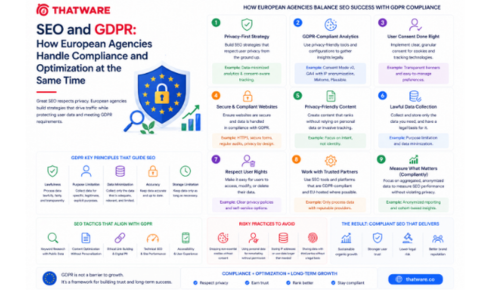
The GDPR conversation in digital marketing usually goes one of two ways. Either it’s dismissed as something the legal team handles and marketing doesn’t need to worry about, or it’s treated as a collection of restrictions that make modern digital marketing impossible. Neither position is useful. Neither is accurate.
The reality for European brands running SEO programmes is that GDPR compliance and search optimisation can coexist without significant compromise in either direction — but it requires understanding where the actual intersections are, what the real constraints look like, and which of the supposed constraints are real versus misunderstood.
This is a practical guide to those intersections.
Where GDPR and SEO Actually Intersect
The first thing to understand is that GDPR’s direct impact on SEO activity is more limited than many people assume. Most organic search optimisation — creating content, building links, improving technical performance, doing keyword research — doesn’t involve processing personal data and sits entirely outside GDPR’s scope.
The places where GDPR and SEO genuinely intersect are specific:
Analytics and tracking. The measurement tools that SEO practitioners use — Google Analytics, Adobe Analytics, and similar — collect and process personal data in ways that GDPR governs. This doesn’t mean you can’t use analytics tools; it means you need appropriate consent mechanisms, data processing agreements with your analytics providers, and data retention settings that comply with your privacy policy.
Cookie consent and its impact on data collection. Properly implemented cookie consent — which requires genuine opt-in for non-essential cookies in most EU member states — reduces the volume of analytics data collected. Users who decline cookies are not tracked in most analytics implementations, creating data gaps that affect how well you can measure SEO performance.
Search Console data (which is GDPR-compliant). One of the most useful practical implications of GDPR for SEO practitioners: Google Search Console data is not cookie-dependent and remains fully available regardless of user consent choices. For many SEO measurement purposes, Search Console data is more reliable post-GDPR than analytics data precisely because it doesn’t require cookie consent.
The Analytics Data Quality Problem
The most practical GDPR challenge for SEO practitioners in European markets is the degradation of analytics data quality from consent rejection.
In markets with high privacy consciousness — Germany, Netherlands, France — consent acceptance rates for non-essential cookies can be 50% or lower. This means that the analytics data you’re working with reflects, at best, half of your actual user population. The half that consents may have systematically different behaviour from the half that doesn’t, creating measurement bias that can mislead optimisation decisions.
Seo agency europe operations working with European clients have had to adapt their measurement methodologies to account for this reality. The approaches that have emerged include:
Server-side analytics, which processes some data without relying on client-side cookies and can capture more of the user population within appropriate privacy boundaries. Aggregated data modelling, where analytics platforms use statistical modelling to estimate full-population behaviour from the consenting sample. Search Console as a primary data source, with analytics as supplementary context rather than primary measurement.
None of these approaches fully restores the measurement precision that pre-GDPR analytics provided. But they produce workable insight for SEO decision-making in a compliant environment.
Consent Management Platform Implementation and Its SEO Implications
Properly implemented GDPR cookie consent requires a Consent Management Platform (CMP) — the cookie banner system that presents users with consent choices when they visit a site.
CMP implementation has direct SEO implications that many implementations handle poorly.
The most common issue: CMPs that block content or page rendering until consent is given. A CMP that prevents page content from loading until the user interacts with the consent banner creates a significant page experience problem — both for users (who experience delay and friction) and potentially for search engine crawlers (which may not be receiving appropriate signals from pages where rendering is consent-blocked).
CMPs should be implemented in ways that: serve full page content to all users regardless of consent status, allow search engine crawlers to access and index pages normally, don’t create content behind paywalls or gates that crawlers can’t access, and don’t generate crawlable URL variants based on consent state.
The technical implementation of a GDPR-compliant CMP without compromising crawlability and indexation is a specific technical challenge that European SEO practitioners deal with regularly.
Content Marketing and GDPR
The content production side of SEO is largely unaffected by GDPR — creating, publishing, and distributing content doesn’t typically involve processing personal data. But there are a few intersections worth noting.
Lead magnet and gated content: using content assets to capture email addresses requires appropriate consent language under GDPR. The consent must be separate from the content delivery — bundling “submit your email to download” as implied consent for marketing is not GDPR-compliant. This affects how content lead generation programmes are structured, not whether they can happen.
On-site search data: if your site tracks what users search for internally, that search data may constitute personal data processing under GDPR depending on implementation. The implications depend on how the data is collected and stored.
User-generated content: reviews, comments, and user contributions involve personal data considerations around storage, retention, and subject access requests that should be addressed in site design.
Link Building in the European Privacy Context
GDPR has a specific and somewhat counterintuitive implication for link building: outreach email requires a legitimate basis.
Cold email outreach to website owners requesting links — a standard link building practice globally — requires a legitimate basis under GDPR when the recipient is in the EU. The legitimate interest basis can apply for B2B outreach where there’s genuine relevance, but it’s not unlimited permission for mass unsolicited email. This doesn’t eliminate link outreach as a practice, but it creates a need for more targeted, genuinely relevant outreach rather than mass email campaigns.
The practical response from seo services europe providers has been to move toward higher-quality, more targeted outreach — which tends to produce better links anyway — and to rely more heavily on content-driven link acquisition (creating linkable assets that attract links organically) rather than outreach-driven acquisition.
The Cross-Border Data Transfer Question
For European SEO agencies working with tools hosted outside the EU — which includes most of the major SEO toolset (Ahrefs, SEMrush, Screaming Frog cloud, many rank tracking tools) — the cross-border data transfer question is relevant.
Post-Schrems II, the transfer of personal data from the EU to the US requires either Standard Contractual Clauses (SCCs) or, since the EU-US Data Privacy Framework was adopted in 2023, certification under that framework. Most major SEO tool providers have addressed this through appropriate compliance documentation.
For European brands using US-based SEO tools, reviewing the data processing agreements and transfer mechanisms in place is a due diligence item — not necessarily a blocker, but something that should be verified rather than assumed.
Building Compliant, High-Performance SEO in the EU
The overarching message for European brands approaching SEO compliance is that the constraints are real but manageable, and that compliant SEO practice and effective SEO practice are largely the same thing.
The brands that treat GDPR as an obstacle to work around tend to create more risk than they realise — both regulatory risk from non-compliant practices and business risk from poor data quality that leads to bad decisions.
The brands that build compliance into their SEO and analytics infrastructure from the start — with compliant CMPs that don’t compromise crawlability, server-side analytics that maximise compliant data collection, and measurement methodologies that work with the available data — find that they can run effective SEO programmes within the GDPR framework.
It requires more careful implementation and more sophisticated measurement methodology than pre-GDPR SEO. But it’s entirely workable, and getting it right produces a genuinely competitive advantage over competitors who are running non-compliant programmes that create legal exposure.